
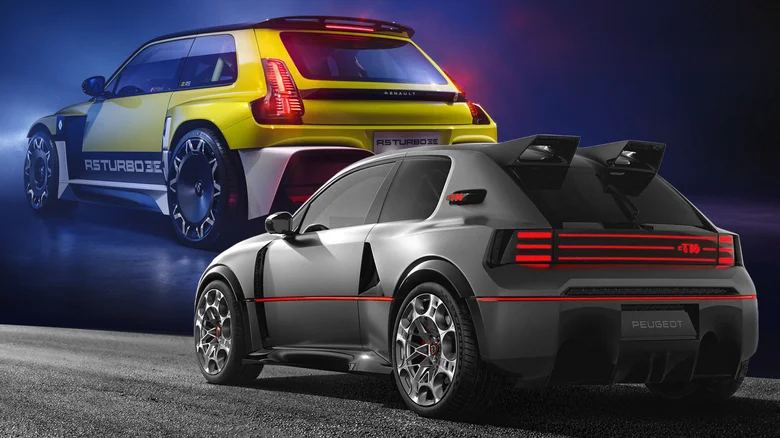
Tell an eighties Group B spectator that the era’s outrageous rally cars would return four decades later without using a drop of gasoline, and they would probably laugh. Yet Renault and Peugeot have done exactly that, replacing the turbocharged engines of their icons with electric motors and battery packs.
These are spiritual successors to the mid-engine, rear-wheel-drive Renault 5 Maxi Turbo and the all-wheel-drive Peugeot 205 T16, reimagined as fully electric, wide-bodied hyper hatchbacks. To compare them, we assembled their images and specifications before either car has been driven back to back. Renault revealed the Turbo 3E as a retro-inspired concept in 2022 before developing it into a limited-production, 535-hp supercar special for 2025. Peugeot followed with the e-T16 concept in 2026, with production potentially arriving in 2027.
Although both cars draw on motorsport legends, their design missions differ. Renault’s model is a flagship performance EV positioned between the classic R5 Turbo and the new R5 E-Tech. Peugeot’s car is a more discreetly disguised preview of the highly aggressive 208 hatchback expected in 2027. Since both electric rally-inspired machines target a similar audience, collectors may struggle to choose between them—or decide they need both.
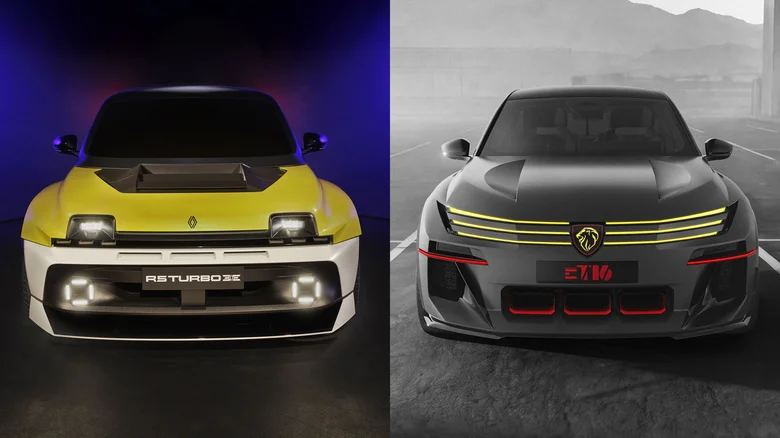
The R5 Turbo 3E’s exterior is a thoroughly modern interpretation of its legendary Group B predecessor, combining futuristic lighting, advanced aerodynamic detailing, and 20-inch alloy wheels. Peugeot’s e-T16 embraces a more contemporary look while preserving the 205’s character through its distinctive greenhouse, red accents, and squared-off taillights. Its new three-slot, full-width LED headlight and taillight graphics are intended to become a recognizable feature of future Peugeots.
The Peugeot also wears slightly larger 21-inch wheels and wider rear tires. Both cars remain faithful to their racing influences with aggressive bumper intakes, prominent splitters, extremely wide fenders with integrated vents, deep side skirts, large rear diffusers, and roof spoilers. And while today’s production superminis generally use five doors, these French hyper hatchbacks retain the traditional three-door configuration.
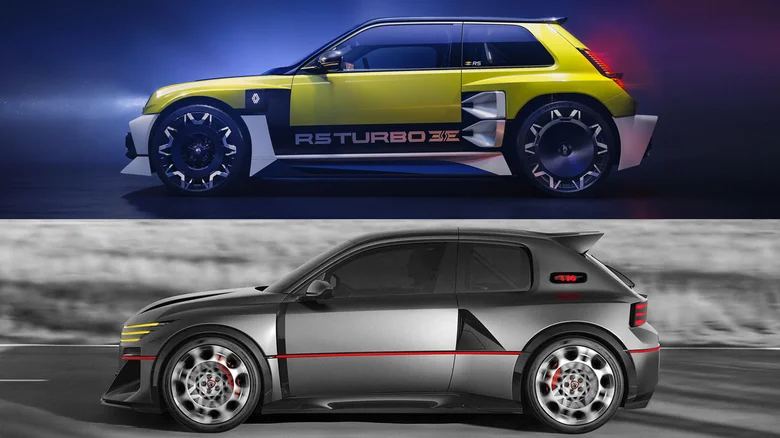
The original Group B hatchbacks were created by removing the rear seats and mounting a combustion engine behind the driver. Their modern descendants recreate that mid-engined character through EV packaging. Renault uses a bespoke aluminum tubular chassis developed by Alpine, while its floor-mounted 70-kWh battery helps produce a 43/57 weight distribution. Like the original, the R5 Turbo 3E sends its power to the rear wheels.
Two electric motors deliver a combined 555 horsepower (410 kW/563 PS), enabling the Renault to reach 100 km/h (62 mph) from rest in under 3.5 seconds. At 1,450 kg (3,197 lbs), it is also the lighter of the two. Peugeot uses Stellantis’ new STLA One global architecture but preserves the 205 T16’s all-wheel-drive layout. Three electric motors generate 816 hp (600 kW/827 PS), comfortably surpassing the output of the original Group B rally cars.
The Peugeot accelerates from 0-100 km/h (0-62 mph) in just 2.5 seconds. Its 85-kWh battery is claimed to provide enough energy for three consecutive Nürburgring laps. Peugeot has not disclosed an exact curb weight, but its stated power-to-weight ratio of under 2 kg/hp (4.4 lbs/hp) suggests a figure of about 1,632 kg (3,590 lbs). With a suitable charger, Renault quotes around 15 minutes for a 15-80% charge, while Peugeot claims roughly the same time for a 10-80% charge.
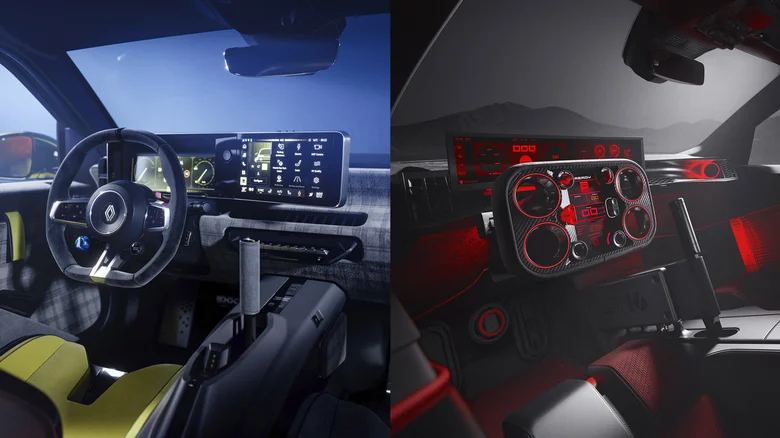
Inside, both EVs are clearly focused on performance. As a production model, the Renault features a conventional steering wheel and a digital cockpit derived from the R5 E-Tech. Peugeot takes a more futuristic approach with its Hypersquare steering wheel and integrated display, paired with a sleek, ultra-wide 21-inch digital instrument cluster. Both cars also feature a vertical hydraulic handbrake, giving drivers the option of sliding through hairpins.
Each model has two seats, heavily bolstered bucket seats, and brightly colored roll cages. The Renault offers a small practical advantage with a conventional boot. Peugeot instead allows the entire rear body section to tilt open, exposing the electric motors and suspension components; whether that unusual feature reaches production remains unknown. Renault will build 1,980 examples of the R5 Turbo 3E, with prices starting at €160,000 ($180,000).
Renault is accepting orders from customers in Europe, the UK, the Middle East, Japan, and Australia, with initial deliveries scheduled for 2027. Peugeot’s e-T16 remains a concept for now, although the brand’s boss has said it could become a production car as early as 2027. If the engineering team can meet that target, another Group B-inspired hyper hatch may soon become reality. With the specifications now laid out, which one would you choose?
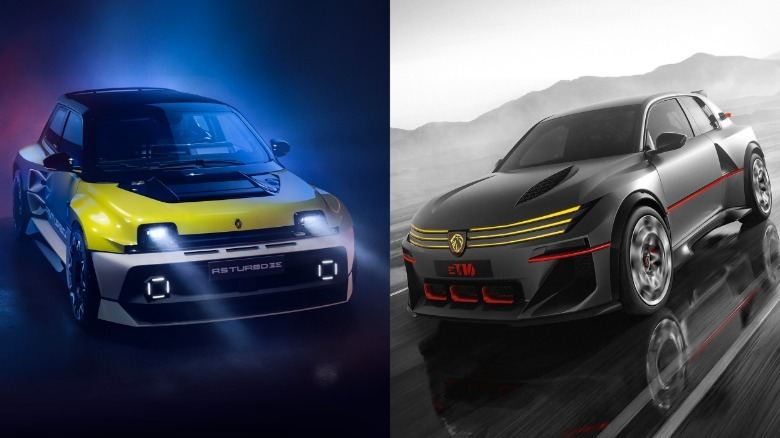
The Renault R5 Turbo 3E and Peugeot e-T16 revive the spirit of the Renault 5 Maxi Turbo and Peugeot 205 T16 with radically different electric powertrains. Renault offers a lighter, rear-drive 555-hp limited-production model, while Peugeot counters with an 816-hp all-wheel-drive concept. With production plans, pricing, and specifications varying between them, both promise a dramatic modern interpretation of Group B performance.


Buick’s Chinese lineup is about to gain a smaller Electra GS plug-in hybrid, highlighting the kind of electrified sedan GM lacks in America.

Kia honored Rafael Nadal with a full-size EV4 GT sculpture made using clay from the courts where the tennis legend earned his “King of Clay” nickname.

Toyota is preparing a specially equipped bZ electric crossover for Waymo’s driverless ride-hailing fleet, with operations planned to begin in Japan in 2027 before expanding to the UK and other supported markets.

Nissan’s SEMA lineup now totals six concepts, led by an especially radical open-top Armada built for extreme off-roading.
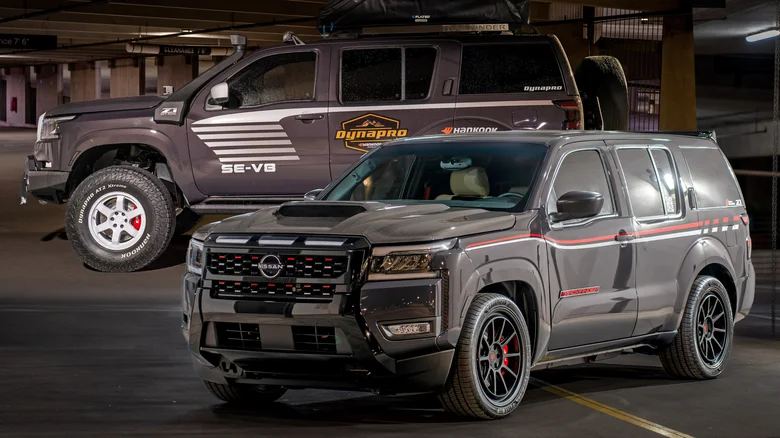
Nismo Nick is bringing two radically different ladder-frame Pathfinder projects—the Trackfinder and Trailfinder—to SEMA in celebration of the nameplate’s 40th anniversary.